Published on:
 Modified on:

 Reading Time: 7 min
 Scientific Articles
Brow lift surgery is a surgical procedure used to correct brow descent and improve the appearance of the forehead and periocular region. Available PubMed meta-analyses indicate that endoscopic brow lift surgery generally has a low complication rate, but the most relevant risks include asymmetry, forehead contour irregularities, unfavorable scarring, recurrence of brow ptosis, sensory changes and the need for revision surgery. The most recent evidence suggests that surgical technique, fixation method and patient selection significantly influence the safety and stability of the outcome.
 Table of Contents:
-
1
 How the evidence was selected
-
2
Most common risks in endoscopic brow lift surgery
-
3
Permanent or temporary fixation: impact on complications
-
4
Recurrence of brow ptosis and stability of the outcome
-
5
Asymmetry and an unsatisfactory aesthetic outcome
-
6
Scarring, irregularities and alterations of the forehead profile
-
7
Sensory changes and superficial neurological risk
-
8
Vascular risk in the frontal region
-
9
Minimally invasive techniques and related complications
-
10
Clinical implications and conclusion
-
11
Bibliography: The five PubMed articles considered
How the evidence was selected
Only PubMed-indexed literature with a systematic review and meta-analysis design was considered. Priority was given to the most recent studies and those most closely related to the topic of brow lift surgery. Directly relevant evidence is limited: a 2026 meta-analysis examines fixation-related complications in endoscopic brow lift surgery, while a 2025 meta-analysis evaluates long-term stability and the risk of brow ptosis recurrence.
Because PubMed does not contain five recent meta-analyses exclusively dedicated to surgical brow lift procedures, related meta-analyses on brow approaches, minimally invasive techniques of the facial region and frontal vascular anatomy were also included, as they are useful for interpreting surgical risk.
Most common risks in endoscopic brow lift surgery
The complications reported in meta-analyses of endoscopic brow lift surgery are generally uncommon. However, the clinically most important risks are asymmetry, contour irregularities, cyst formation, unfavorable scarring and the need for surgical correction. In the 2026 meta-analysis, overall complication rates were low, often below 3%, with some differences between permanent and temporary fixation systems. Even when the absolute risk is low, a small error in fixation, tissue traction or symmetry can produce a visible result.
Permanent or temporary fixation: impact on complications
One of the most important issues concerns the method of forehead fixation. The 2026 meta-analysis compared permanent and temporary fixation in endoscopic subperiosteal brow lift surgery. The data indicate that both approaches are generally safe, but some complications, such as asymmetry, contour irregularities, cyst formation and the need for revision, were more frequent in the permanent fixation group.
This does not mean that permanent fixation is always inappropriate. It means that it should be selected carefully, according to the patient’s anatomy, tissue quality, degree of ptosis and the surgeon’s experience.
Recurrence of brow ptosis and stability of the outcome
Recurrence of brow ptosis is one of the most relevant aesthetic risks after brow lift surgery. In practical terms, the brow may partially descend over time, especially when tissue quality is poor or the ageing process continues to affect the frontal region.
The 2025 meta-analysis on endoscopic brow lift surgery showed that long-term brow elevation is measurable, but not unlimited:
- approximately 3.25 mm in the medial portion of the brow;
- approximately 3.86 mm in the central portion;
- approximately 4.35 mm in the lateral portion.
These findings are useful for informed consent because they help patients develop realistic expectations. The outcome can be stable and natural, but it should not be interpreted as permanent brow elevation in an absolute sense. Longevity depends on the surgical technique, the fixation method, tissue quality and the normal ageing process.
Asymmetry and an unsatisfactory aesthetic outcome
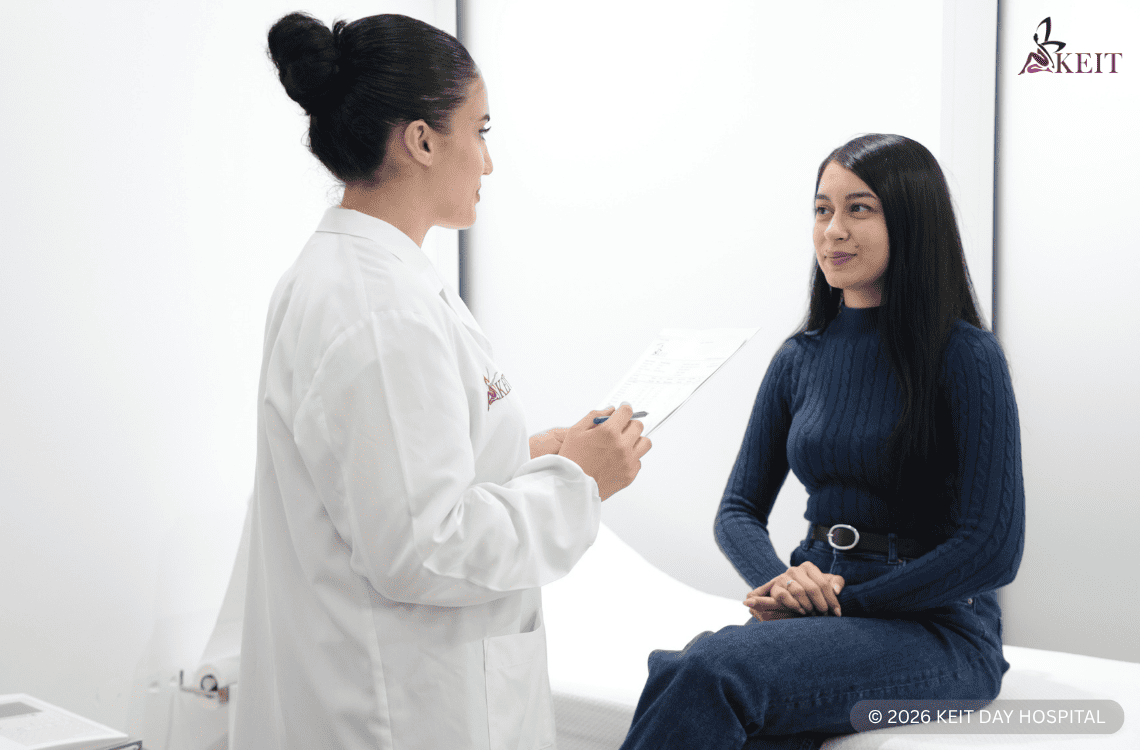
Asymmetry is one of the most delicate complications of brow lift surgery because even a small difference between the two sides may become visible in the eye and forehead region. It may depend on several factors, such as imperfectly balanced fixation, differences in tissue elasticity between the two sides, uneven tissue traction or ptosis already present before surgery.
For this reason, preoperative assessment is essential. The surgeon should evaluate the face not only at rest but also during facial expressions, because movement of the forehead and brows can greatly influence the final outcome.
Scarring, irregularities and alterations of the forehead profile
Visible scars and forehead contour irregularities are less common complications, but they are important considerations in brow lift surgery. Even minor alterations in the forehead or hairline region may affect the natural appearance of the aesthetic result. Evidence from endoscopic brow lift surgery indicates that the risk may vary according to the technique used and the fixation method. Excessive tension, inadequate dissection or poorly distributed fixation may increase the likelihood of unfavorable scarring, contour irregularities or an unnatural appearance of the forehead.
Individual patient characteristics also play an important role. Skin quality, a personal tendency toward scar formation, previous surgical procedures and tissue thickness may influence both the healing process and the final outcome.
Sensory changes and superficial neurological risk
Temporary sensory changes may occur after brow lift surgery in the forehead, scalp or brow region. Patients may experience numbness, tingling or altered sensation compared with normal. This risk is related to the presence of small sensory nerves in the frontal region. During surgery, tissue dissection and elevation should respect these anatomical planes in order to reduce the risk of nerve irritation or injury.
Although some of the evidence derives from non-aesthetic surgical procedures performed in the same anatomical region, the principle remains relevant: the brow region is delicate and requires precise technique because nerves, blood vessels and soft tissues are located very close to one another.
Vascular risk in the frontal region
In brow lift surgery, safety also depends on precise knowledge of the blood vessels of the forehead. Important arteries, such as the supraorbital artery and the supratrochlear artery, pass through this region and must be preserved during surgical dissection. Anatomical evidence shows that the depth and course of these vessels may vary from patient to patient. For this reason, the surgeon should work within the correct anatomical plane and adapt the technique to the individual structure of the forehead.
An inadequate plane of dissection may increase the risk of bleeding, hematoma, tissue trauma or postoperative irregularities. Careful planning and surgical experience are therefore essential to reduce vascular complications and achieve a safer and more natural result.
Minimally invasive techniques and related complications
Minimally invasive techniques for lifting facial tissues, such as suspension threads, are not the same as surgical brow lift procedures. However, they may provide useful information regarding the risks associated with tissue traction. A 2021 meta-analysis reported several complications associated with suspension threads, including swelling, skin irregularities, paresthesia, visibility or palpability of the threads, infection and thread extrusion.
These findings should not be applied directly to endoscopic brow lift surgery because they involve different procedures. However, they confirm an important principle: any technique that lifts tissues through traction may cause asymmetry, irregularities or sensory changes if the indication is not appropriate or if the technique is not performed accurately.
Clinical implications and conclusion
The available evidence indicates that brow lift surgery, especially with the endoscopic technique, generally has a favorable safety profile. However, it is not a risk-free procedure.
- The most relevant complications include asymmetry, recurrence of ptosis, unfavorable scarring, forehead contour irregularities, sensory changes and the possible need for revision.
- The outcome depends greatly on the surgical technique, the fixation method and correct patient selection.
- Knowledge of frontal anatomy, particularly nerves and blood vessels, is essential to reduce the risk of complications.
- Accurate preoperative assessment helps identify pre-existing asymmetries, tissue quality, degree of ptosis and realistic expectations.
- The success of the procedure does not consist only in lifting the brow, but in achieving a stable, symmetrical, natural result consistent with the patient’s anatomy.
- PubMed literature still contains few meta-analyses specifically focused on surgical brow lift. For this reason, conclusions should be interpreted with caution and should not be presented as definitive.
Bibliography: The five PubMed articles considered
Graf AE, Kang JM, Ferzli G, Rosenfeld RM, Romo T. Endoscopic-assisted, subperiosteal browlift bone fixation technique outcomes: a systematic review and meta-analysis. Plastic and Reconstructive Surgery. 2026. PMID: 41697229.
Şibar S, Uğraş Dikmen A, Işık Erdal A. Long-term Stability in Endoscopic Brow Lift: A Systematic Review and Meta-Analysis of the Literature. Aesthetic Surgery Journal. 2025. PMID: 39542644.
Pivazyan G, Aguilera C, Liu J, Khan Z, Wong GM, et al. Clinical outcomes and complications of eyelid versus eyebrow approaches to supraorbital craniotomy: systematic review and indirect meta-analysis. Neurosurgical Focus. 2024. PMID: 38560941.
Trzeciak M, et al. Depth of arterial supply of forehead: a meta-analysis. Folia Morphologica. PMID: 39764659.
Niu Z, et al. A Meta-Analysis and Systematic Review of the Incidences of Complications Following Facial Thread-Lifting. Aesthetic Plastic Surgery. 2021. PMID: 33821308.