Published on:
 Modified on:

 Reading Time: 5 min

 Scientific Articles
Venous thromboembolism (VTE) is one of the most feared systemic complications in cosmetic surgery because it can progress from deep vein thrombosis to pulmonary embolism, even in apparently healthy patients. The most recent PubMed evidence indicates that the risk does not depend on a single factor, but on the interaction between the patient's individual risk profile, the type of procedure, operative duration and the quality of perioperative prevention. This review analyzes the available meta-analytic data on abdominoplasty, liposuction, risk stratification using the Caprini score and thromboprophylaxis, with the aim of clarifying when VTE is predictable, preventable and clinically relevant.
 Table of Contents:
-
1
 How the most recent PubMed evidence was selected
-
2
Venous thromboembolism in cosmetic surgery: why it is rare but clinically relevant
-
3
Cosmetic procedures associated with a higher risk
-
4
Risk factors for venous thromboembolism in cosmetic surgery
-
5
Prevention of venous thromboembolism in cosmetic surgery
-
6
Clinical implications for VTE prevention in cosmetic surgery
-
7
What pooled evidence indicates about venous thromboembolism prevention
-
8
Bibliography: 5 selected PubMed articles
How the most recent PubMed evidence was selected
Only PubMed-indexed literature with a systematic review, meta-analysis or pooled analysis design relevant to venous thromboembolism, plastic/cosmetic surgery, risk stratification and prevention was considered. Priority was given to the most recent studies with quantitative data applicable to clinical practice.
The final evidence set includes five publications: two 2026 systematic reviews/meta-analyses on VTE prophylaxis in plastic surgery and abdominoplasty, one 2024 meta-analysis on liposuction complications, one 2022 meta-analysis on VTE risk assessment models in plastic surgery and one 2021 pooled analysis on chemoprophylaxis in abdominoplasty.
Venous thromboembolism in cosmetic surgery: why it is rare but clinically relevant
Venous thromboembolism, which includes deep vein thrombosis and pulmonary embolism, is an uncommon complication in cosmetic surgery, but its clinical impact can be significant. The risk increases when individual patient factors, such as obesity, advanced age, a history of thrombosis or a predisposition to coagulation disorders, are combined with procedural factors such as prolonged surgery, combined procedures, extensive body contouring and reduced postoperative mobilization. For this reason, even in an elective and apparently low-risk setting, VTE should be assessed proactively and should not be regarded as an unpredictable or purely accidental event.
Cosmetic procedures associated with a higher risk
Not all cosmetic procedures have the same thromboembolic risk profile. The risk tends to increase when surgery involves large anatomical areas, requires prolonged operative time, limits early mobilization or is combined with other procedures during the same surgical session. For this reason, abdominoplasty and extensive liposuction require specific evaluation during preoperative planning.
Abdominoplasty
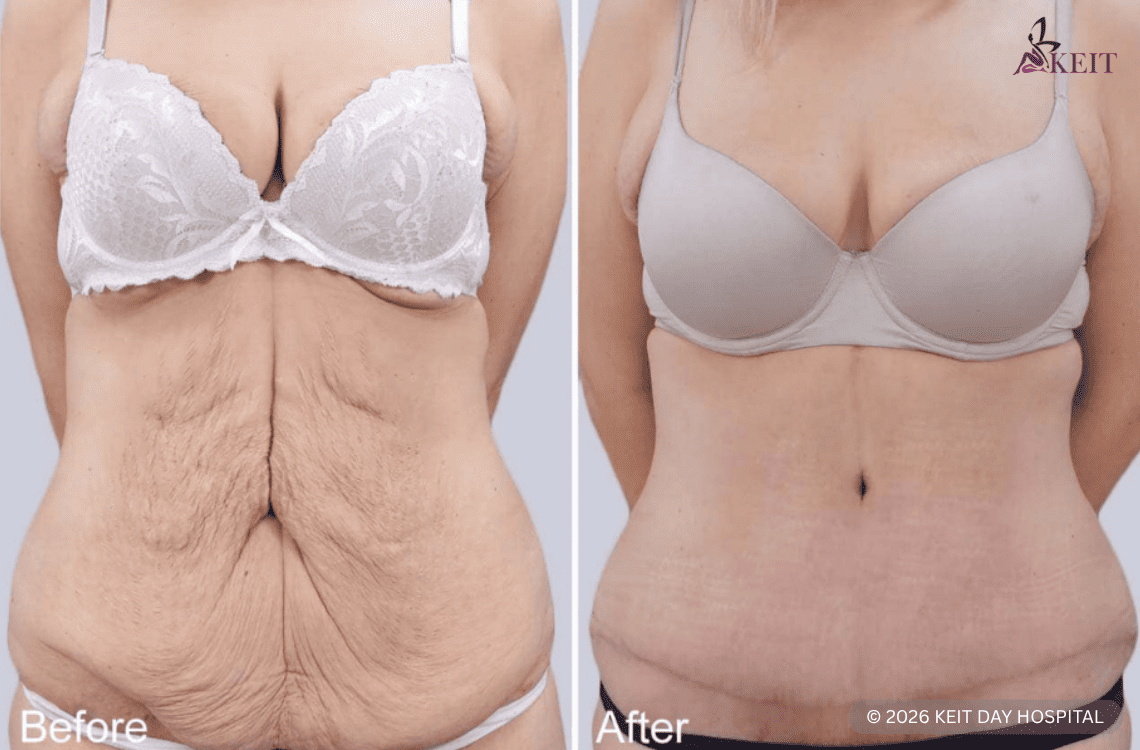
Abdominoplasty emerges as one of the cosmetic procedures most strongly associated with VTE risk, particularly when performed with prolonged operative time, fascial plication, extensive tissue dissection or combined procedures. A pooled analysis of 1,596 patients reported an overall VTE incidence of 0.56%, while also highlighting the heterogeneity of the data and the lack of risk stratification in many studies.
Liposuction and high-volume liposuction
Meta-analyses on liposuction show that VTE is rare, but not negligible in complex cases, particularly when liposuction is extensive, combined with other procedures or performed in patients with systemic risk factors. The 2024 meta-analysis on liposuction complications confirms the importance of evaluating not only the technical risk, but also the patient’s overall risk profile.
Risk factors for venous thromboembolism in cosmetic surgery
The risk of venous thromboembolism in cosmetic surgery increases when individual and surgical factors combine. PubMed evidence identifies the following as the most relevant:
- Previous episode of venous thromboembolism or known thrombophilia;
- Obesity or elevated BMI;
- Advanced age;
- Estrogen therapy or oral contraceptives;
- Smoking;
- Combined procedures;
- Prolonged operative duration;
- Delayed postoperative mobilization;
- Abdominoplasty and extensive body contouring;
- Elevated Caprini score.
The meta-analysis on risk models in plastic surgery indicates that the Caprini Risk Assessment Model is more predictive than the ASA score in identifying patients at risk of postoperative VTE. For this reason, prevention should begin with structured preoperative risk stratification, rather than a generic patient assessment.
Prevention of venous thromboembolism in cosmetic surgery
VTE prevention should be individualized. Pharmacological prophylaxis may reduce risk in high-risk patients, but it may increase bleeding or hematoma if used without a clear indication.
The most supported strategies include:
- Preoperative assessment using the Caprini score;
- Intraoperative intermittent pneumatic compression;
- Compression stockings in selected patients;
- Early mobilization;
- Reducing operative time when possible;
- Avoiding excessively long surgical combinations in high-risk patients;
- Chemoprophylaxis with low-molecular-weight heparin only when the risk-benefit balance is favorable.
The most recent reviews question routine chemoprophylaxis in abdominoplasty: the benefit for VTE is not always consistent, while the risk of bleeding may increase. The best prevention is therefore stratified, not automatic.

Clinical implications for VTE prevention in cosmetic surgery
VTE in cosmetic surgery is rare, but it should not be considered a marginal risk. Effective prevention begins with patient selection and preoperative risk stratification, not with the automatic prescription of anticoagulants.
In low-risk patients, mechanical measures, early mobilization and appropriate surgical planning may be sufficient. In high-risk patients, especially in cases of abdominoplasty or combined body contouring, chemoprophylaxis should be evaluated individually, balancing VTE reduction against bleeding risk.
What pooled evidence indicates about venous thromboembolism prevention
Overall, pooled evidence suggests that:
- Venous thromboembolism is rare in cosmetic surgery, but its clinical impact justifies structured preoperative assessment;
- Risk is not uniform: it increases especially in abdominoplasty, extensive body contouring, complex liposuction and combined procedures;
- Patient factors matter as much as the procedure: elevated BMI, advanced age, thrombotic history, estrogen therapy and a high Caprini score modify the risk profile;
- Mechanical prophylaxis and early mobilization play a central role in prevention;
- Chemoprophylaxis should be reserved for selected patients, because the benefit in reducing venous thromboembolism must be balanced against the risk of bleeding or hematoma;
- The strongest strategy is not “more anticoagulants for everyone,” but targeted prevention based on individual risk.

Bibliography: 5 selected PubMed articles
Swanson E. A Systematic Review of the Efficacy of Venous Thromboembolism Prevention Protocols in Abdominoplasty Patients and the Risk of Bleeding. 2026. PMID: 41576238.
Zhou SY. Rethinking Venous Thromboembolism Prophylaxis in Plastic and Reconstructive Surgery: A Meta-analysis of Efficacy and Safety Outcomes. 2026. PMID: 41629469.
Comerci AJ. Risks and Complications Rate in Liposuction: A Systematic Review and Meta-Analysis. Aesthetic Surgery Journal. 2024. PMID: 38563572.
Mrad MA. Venous Thromboembolism Risk Assessment Models in Plastic Surgery: A Systematic Review and Meta-Analysis. Plastic and Reconstructive Surgery Global Open. 2022. PMID: 36518690.
Perzia BM. Venous Thromboembolism and Bleeding Events With Chemoprophylaxis in Abdominoplasty: A Systematic Review and Pooled Analysis of 1596 Patients. Aesthetic Surgery Journal. 2021. PMID: 33599713.