Published on:
 Modified on:

 Reading Time: 6 min
 Scientific Articles
This evidence review synthesizes recent PubMed-indexed systematic reviews and meta-analyses on dermal filler complications. The selected studies focus on complication incidence, vascular and ocular adverse events, anatomical and procedural risk factors, and treatment outcomes in cases requiring urgent management. To maintain a high methodological standard, only meta-analyses and systematic reviews with quantitative synthesis were considered. The final evidence set includes five recent PubMed-indexed articles published between 2023 and 2025, chosen for their direct relevance to dermal filler safety and complications.
 Table of Contents:
-
1
 How the evidence was selected: Criteria for the latest PubMed meta-analytic evidence
-
2
Common filler complications: what pooled evidence shows most often
-
3
Severe complications: vascular occlusion, skin necrosis, and visual loss
-
4
Anatomical and procedural risk factors: Where complications cluster
-
5
Reversibility and prognosis: why some complications resolve and others do not
-
6
Management evidence: what meta-analyses suggest about hyaluronidase
-
7
Key risk themes identified across the evidence
-
8
Clinical implications: What the evidence means for practice
-
9
Bibliography: Recent PubMed-indexed meta-analyses considered
How the evidence was selected: Criteria for the latest PubMed meta-analytic evidence
A targeted PubMed search strategy was used to identify recent meta-analyses and pilot meta-analyses on dermal filler complications. Priority was given to studies that were indexed in PubMed, used quantitative meta-analytic pooling, focused specifically on dermal filler adverse events or their management, and reported findings that were clinically interpretable rather than purely narrative.
The final evidence set includes five recent papers. These comprise a 2025 meta-analysis on ocular complications after hyaluronic acid filler, a 2025 meta-analysis on hyaluronidase management of hyaluronic-acid-related vascular complications, a 2025 meta-analysis on risk factors for vascular occlusion after dermal filler injections, a 2024 pilot meta-analysis comparing high-dose and low-dose hyaluronidase for filler-related skin necrosis, and a 2023 meta-analysis on adverse events after hyaluronic acid filler injections in the facial region.
Common filler complications: what pooled evidence shows most often
Across recent meta-analyses, the most common dermal filler complications are local and usually non-catastrophic. These are the reactions most often reported in routine clinical practice and generally include:
- Swelling or edema
- Bruising or ecchymosis
- Erythema
- Tenderness or pain
- Lumps, bumps, or firmness, and
- Contour irregularity or discoloration.
The 2023 meta-analysis on facial hyaluronic acid filler injections found that these events make up the main cluster of reported adverse effects, with some variation depending on the treatment area. In particular, swelling, palpable irregularities, and firmness differed between nasolabial fold injections and other facial regions.
A 2024 meta-analysis focused on the tear trough provides a more specific anatomical example. In that analysis, pooled complication rates were 19.2% for swelling or edema, 18.4% for bruising or ecchymosis, 7.1% for erythema, 5.3% for contour irregularity or lumps, and 0.9% for blue discoloration or Tyndall effect. These findings show that complication profiles can vary by anatomical site, even when severe events remain uncommon.
Severe complications: vascular occlusion, skin necrosis, and visual loss
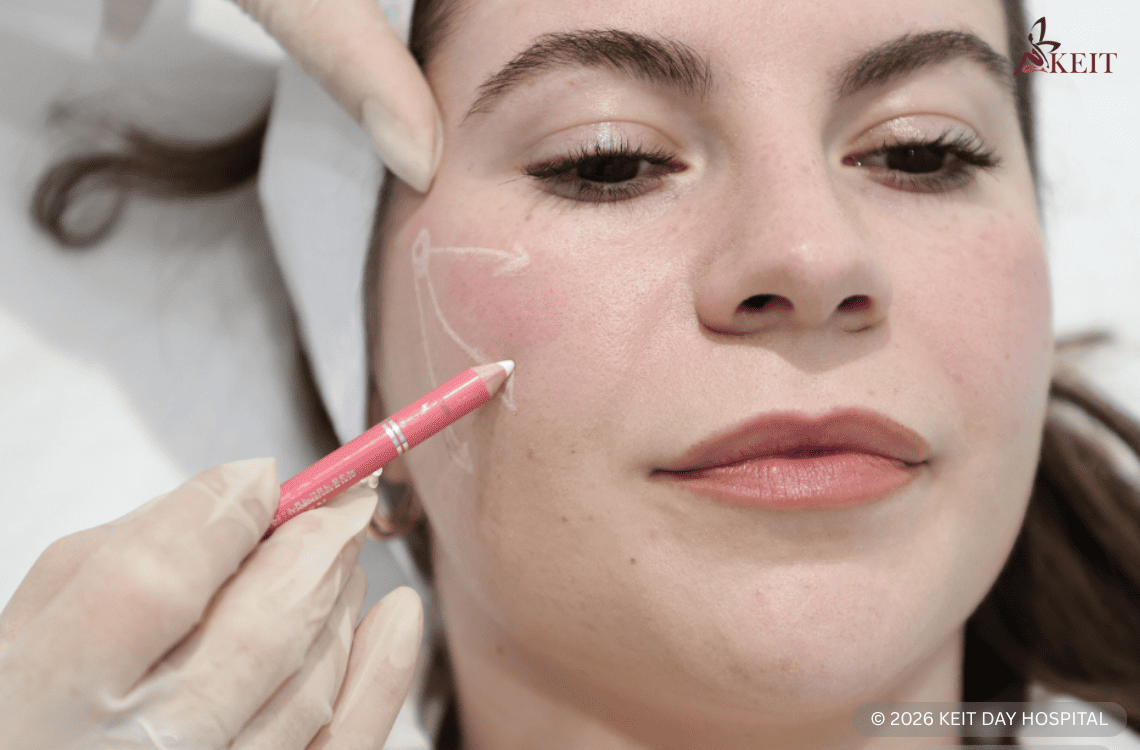
Pooled evidence highlights three main points:
- A 2025 meta-analysis on ocular complications after hyaluronic acid filler reported a pooled visual acuity recovery rate of 27.3%, indicating that visual recovery is often incomplete once embolic injury occurs.
- The same analysis found that the nasal area was the injection site most often linked to visual impairment, with ptosis and extraocular movement limitation among the most frequent associated findings.
- A separate 2025 meta-analysis on vascular occlusion showed that outcome depends heavily on early recognition and treatment, with delayed management associated with a higher risk of permanent deficits.
The clinical implication is straightforward: although these complications are uncommon, they must be managed as time-sensitive medical emergencies.
Anatomical and procedural risk factors: Where complications cluster
Pooled evidence suggests that severe filler complications are not random and tend to cluster in specific facial areas. The main signals are consistent:
- The 2025 meta-analysis on vascular occlusion identified the glabella, nose, and nasolabial folds as the regions most often involved in serious vascular events.
- The 2025 meta-analysis on ocular complications found that visual loss was linked mainly to nasal injections, confirming the nose as one of the highest-risk filler sites.
Overall, complication risk appears to depend on several factors, including the anatomy of the injection site, the caliber and connectivity of local vessels, the depth and plane of injection, and the speed with which a vascular event is recognized and managed. In practice, this means that both the location of the injection and the timeliness of intervention play a critical role in determining clinical outcomes.
Reversibility and prognosis: why some complications resolve and others do not
Meta-analytic evidence shows a clear difference between mild local reactions and vascular-ischemic complications. Reactions such as swelling, bruising, and minor contour irregularities usually improve with time and tend to have a favorable short-term course. In contrast, complications linked to vascular compromise, especially visual loss and established ischemic injury, are associated with a much poorer prognosis.
This distinction is clinically important. It shows that dermal filler complications should not be discussed as a single uniform category. Most are self-limited, but a smaller group can threaten function and therefore require immediate recognition, referral, and treatment.
Management evidence: what meta-analyses suggest about hyaluronidase
For hyaluronic-acid-related vascular complications, hyaluronidase remains the main rescue treatment supported by recent meta-analytic evidence. The key findings are:
- A 2025 meta-analysis on HA-related vascular complications reported overall resolution rates of 78.4% for skin necrosis and 45.2% for visual impairment. Better outcomes were associated with intervention within 6 hours, and higher hyaluronidase doses were linked to improved resolution in skin necrosis.
- A 2024 pilot meta-analysis focused on skin necrosis after HA fillers found a pooled complete scar-resolution rate of 77.8% after hyaluronidase treatment. Patients treated with 500 IU or less showed a numerically higher complete-resolution rate, although the difference was not statistically significant.
- A 2025 pilot meta-analysis on ultrasound-guided hyaluronidase reported a pooled complete-resolution rate of 94.6% for impending filler-induced facial skin necrosis. These results are promising, but the evidence base was small, including only four studies and 55 patients.
Key risk themes identified across the evidence
Across the five meta-analytic papers, the most consistent complication themes are:
- Most filler adverse events are local and transient, especially swelling, bruising, erythema, and palpable irregularities.
- The most serious complications are vascular, especially ischemia, skin necrosis, and ocular injury.
- High-risk anatomy matters, with the nose, glabella, and nasolabial region appearing repeatedly in pooled analyses of severe events.
- Timing of intervention matters, because earlier recognition and treatment are associated with better recovery.
- Visual recovery remains poor overall, even with treatment, making prevention more important than salvage in ocular complications.
Clinical implications: What the evidence means for practice
Across the recent PubMed meta-analyses, several practical implications emerge consistently:
- Vascular complications remain the most clinically significant risk, even if their absolute incidence is low.
- Anatomical site selection and injection precision are central to prevention.
- In hyaluronic-acid-related ischemic events, early hyaluronidase use remains the main evidence-supported response.
- Ultrasound-guided management appears promising, but current evidence is still limited.
For patient counseling, the evidence supports a clear and balanced message: most filler complications are mild and reversible, some facial areas carry higher risk, ocular events are rare but potentially devastating, and delayed treatment is associated with worse outcomes.
Bibliography: Recent PubMed-indexed meta-analyses considered
- Kim H, Woo SJ, Lee W. Systematic review and meta-analysis of ocular complications following hyaluronic acid filler injection. Plast Reconstr Surg. 2025. PMID: 41453353.
- Alhusain AM, et al. Hyaluronidase Protocol in Management of Hyaluronic Acid Filler-Related Vascular Complications: A Systematic Review and Meta-Analysis. Aesthetic Plast Surg. 2025. PMID: 41249530.
- Chakhachiro A, Waseem M. Risk Factor Analysis for Vascular Occlusions After Dermal Filler Injections: A Systematic Review and Meta-Analysis. Cureus. 2025. PMID: 40406769.
- Boey JJE, et al. Conventional High-Dose vs Low-Dose Hyaluronidase for Skin Necrosis after Hyaluronic Acid Fillers: A Systematic Review and Pilot Meta-Analysis. Aesthetic Plast Surg. 2024. PMID: 39214904.
- Colon J, et al. Adverse Events Reported From Hyaluronic Acid Dermal Filler Injections to the Facial Region: A Systematic Review and Meta-Analysis. 2023. PMID: 37261136.