Published on:

 Reading Time: 4 min

 Breast augmentation
Breast implants can be placed above or beneath the pectoral muscle, while dual-plane placement combines elements of both positions. The appropriate implant placement is selected according to the patient’s anatomy, available tissue coverage, implant characteristics and desired result.
 Table of Contents:
-
1
 Breast implant placement: what are the options?
-
2
Breast implants over the muscle: how are they placed?
-
3
Breast implants under the muscle: how are they placed?
-
4
What is dual-plane breast augmentation?
-
5
Breast augmentation over vs under the muscle: key differences
-
6
Over vs under the muscle: how does recovery differ?
-
7
Over vs under the muscle: risks and complications
-
8
How is the right breast implant placement chosen?
In this article, we explain the main breast implant placement options, how implants are positioned over and under the muscle, and what dual-plane breast augmentation involves. We then cover the key differences, recovery, risks and how the right breast implant placement is chosen.
Breast implant placement: what are the options?
Breast implants can be positioned above the pectoral muscle, beneath it, or using a dual-plane technique. The three approaches are:
- Over the muscle (subglandular): The implant is placed beneath the breast tissue and above the pectoralis major muscle.
- Under the muscle (subpectoral): The implant is positioned beneath the pectoralis major muscle, providing additional tissue coverage.
- Dual plane: The upper part of the implant is covered by the pectoral muscle, while the lower part lies beneath the breast tissue.
The choice of implant pocket affects how much soft-tissue coverage surrounds the implant, how the breast moves with the chest muscle and how the augmentation appears.
Breast implants over the muscle: how are they placed?
Over-the-muscle breast implants are placed beneath the breast tissue and above the pectoralis major muscle, a position known as subglandular placement. Because the pectoral muscle does not cover the implant, its visibility and contour are more dependent on the thickness of the overlying breast tissue. This placement also avoids implant movement caused by pectoral muscle contraction.
Breast implants under the muscle: how are they placed?
Under-the-muscle breast implants are positioned beneath the pectoralis major muscle, providing an additional layer of tissue coverage over the implant. This placement is also known as subpectoral or submuscular breast augmentation. The additional coverage can reduce implant visibility and palpability, particularly in patients with limited natural breast tissue. However, because the implant lies beneath the pectoral muscle, muscle contraction can affect its position or the appearance of the breast.
What is dual-plane breast augmentation?
Dual-plane breast augmentation places the upper portion of the implant beneath the pectoral muscle while the lower portion sits beneath the breast tissue. It combines subpectoral coverage of the upper implant with greater expansion of the lower breast. The technique was developed to address situations in which complete submuscular coverage may limit the desired lower-pole shape. It can therefore provide additional upper-pole coverage while allowing the lower part of the breast to expand around the implant.
Breast augmentation over vs under the muscle: key differences
The main differences between breast augmentation over and under the muscle are implant coverage, breast contour, muscle movement and implant visibility.
| Factor | Over the muscle | Under the muscle |
|---|---|---|
| Implant position | Beneath breast tissue, above the pectoral muscle |
Beneath the pectoral muscle |
| Soft-tissue coverage | Provided by breast tissue | Provided by breast tissue and pectoral muscle |
| Implant visibility | More dependent on tissue thickness |
Reduced by additional muscle coverage |
| Pectoral muscle movement |
Does not directly move the implant |
Muscle contraction can affect implant movement or shape |
| Upper-pole contour | More direct implant projection | Greater upper-pole tissue coverage |
Over vs under the muscle: how does recovery differ?
Over-the-muscle breast augmentation has a shorter and more comfortable early recovery than under-the-muscle placement. Because the pectoral muscle is not manipulated, patients experience less muscle-related pain and tightness. Under-the-muscle breast augmentation can cause greater early pain, tightness and pressure because the pectoral muscle is stretched to accommodate the implant. Swelling and discomfort can therefore take longer to settle.
In both procedures, swelling and discomfort are greatest during the first few days and gradually improve during the following weeks. The overall recovery period varies according to the surgical technique and individual healing response.

Over vs under the muscle: risks and complications
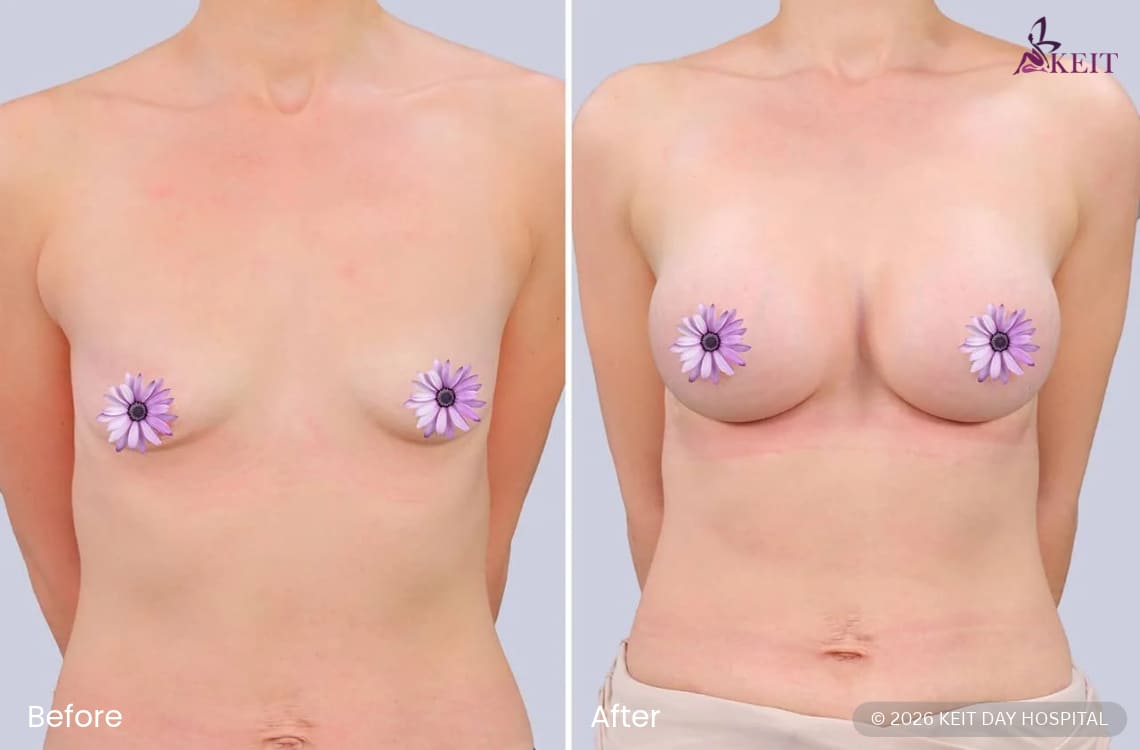
With over-the-muscle implants, limited breast tissue coverage can increase the risk of implant visibility, palpability and rippling. With under-the-muscle implants, pectoral muscle contraction can cause animation deformity, resulting in temporary changes in breast shape or implant position. Muscle-related implant displacement can also occur.
Both placements carry general breast implant risks, including infection, bleeding, asymmetry, malposition, capsular contracture, implant rupture and the potential need for revision surgery.
How is the right breast implant placement chosen?
The right breast implant placement is chosen according to the patient’s breast anatomy, available tissue coverage, chest structure and desired result. The surgeon assesses these factors together with the implant size and profile to determine whether over-the-muscle, under-the-muscle or dual-plane placement is most appropriate.