
 info@keit.al
 Tirana: +355 68 20 00 622
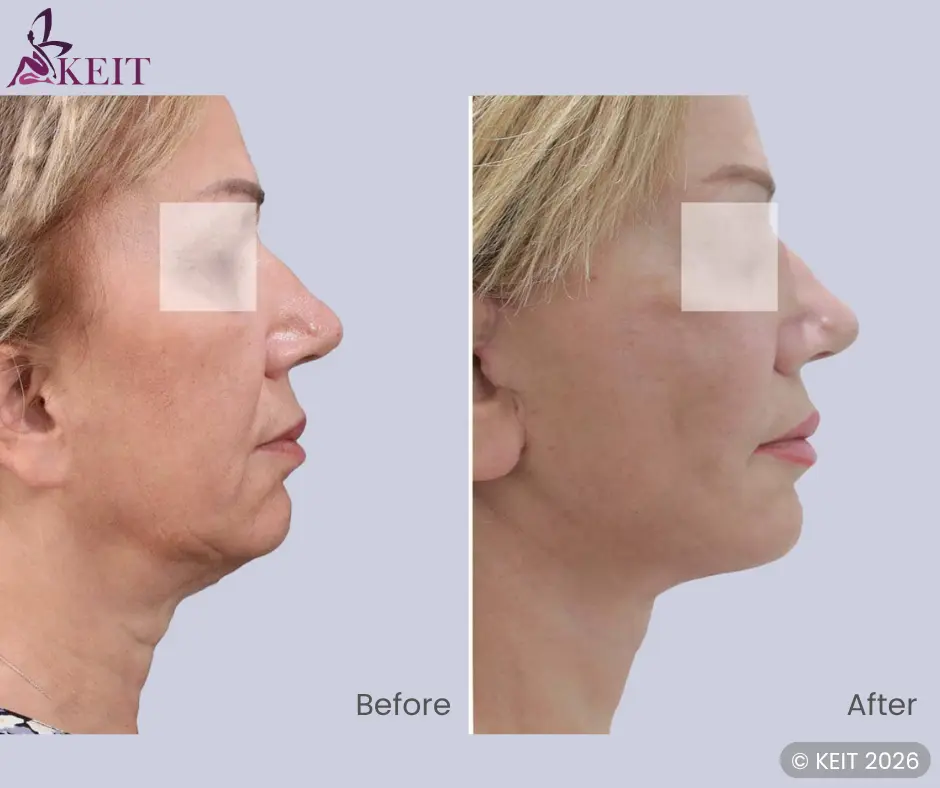
In this article, we explain what turkey neck is, the anatomical changes that contribute to its development, and the signs used to identify neck laxity. We also discuss how turkey neck is evaluated, the most effective treatment options, when a neck lift is recommended, and what patients can expect during recovery and after surgery.
Published on: 28/08/2026
 11 Min
Turkey Neck: Causes, Signs, Treatments and Neck Lift Surgery

Edited by Dr. Skerdi Faria, with the contribution of the Scientific Committee of the KEIT Day Hospital.
Turkey neck is the appearance of loose, sagging neck skin and reduced neck definition caused by changes in the skin, platysma muscle, and underlying soft tissues. It can result from ageing, genetics, weight changes, and loss of tissue elasticity. Treatment depends on the severity of neck laxity and may include non-surgical tightening procedures or neck lift surgery for more advanced cases.
Table of Contents:
What is turkey neck?
Turkey neck is an aesthetic condition characterised by loose, sagging neck skin and reduced definition of the neck contour due to changes in the supporting tissues of the neck. It involves laxity of the cervical soft tissues, including the skin and platysma muscle, which contribute to the structure and appearance of the neck. When these tissues lose their firmness and support, the neck contour becomes less defined and the transition between the jawline and neck changes.
What causes turkey neck?
Turkey neck develops due to age-related changes in the skin, muscles, and soft tissues of the neck, combined with factors such as genetics and weight fluctuations. The main contributing factors include:
– Loss of collagen and elastin: Reduced skin elasticity and firmness with ageing.
– Platysma muscle changes: Weakening or separation of the neck muscle affecting neck support.
– Fat redistribution: Changes in fat volume under the chin and around the neck altering contour.
– Weight fluctuations: Skin stretching and reduced retraction after significant weight changes.
– Genetics and skin quality: Individual differences in skin structure affect how neck laxity develops.
– Sun exposure and smoking: Accelerate collagen breakdown and skin ageing.
What are the signs of turkey neck?
The main signs of turkey neck are loose neck skin, reduced jawline definition, and visible changes in the neck contour caused by ageing-related tissue laxity. Common aesthetic signs include:
– Loose or sagging skin under the chin, creating excess tissue and a less defined neck contour.
– Vertical neck bands caused by changes in the platysma muscle, which may become more visible with movement.
– Neck wrinkles and skin creasing due to reduced skin firmness and elasticity.
– Loss of jawline definition as the transition between the lower face and neck becomes less distinct.
– Fullness under the chin caused by changes in soft tissue volume and fat distribution.

How is turkey neck evaluated?
Turkey neck is evaluated through a clinical examination that assesses skin laxity, muscle changes, fat distribution, and overall neck anatomy. During assessment, a specialist evaluates:
– Skin laxity and elasticity to determine the degree of loose skin and tissue quality.
– Platysma muscle changes to identify muscle laxity or visible banding affecting the neck contour.
– Submental fat to assess whether excess fat under the chin contributes to the appearance of the neck.
– Neck and jawline contour to evaluate the relationship between the lower face and neck.
– Overall facial ageing pattern to determine whether neck changes are isolated or part of broader facial ageing.
The evaluation helps determine the most appropriate treatment approach based on the specific anatomical changes present.
🩺 Talk to one of our Italian surgeons and find out if you’re eligible for the procedure.
What are the most effective treatments for turkey neck?
The most effective turkey neck treatment depends on the degree of skin laxity, muscle changes, and excess fat present.
Non-surgical treatments are suitable for mild to moderate neck laxity and aim to improve skin firmness and quality. However, they cannot correct significant excess skin or advanced muscle laxity.
– Radiofrequency skin tightening: Stimulates collagen production to improve skin firmness.
– Ultrasound-based skin tightening: Uses focused energy to promote tissue tightening.
– Injectable treatments: May improve specific concerns such as muscle activity or skin quality in selected patients.
Surgical treatment is considered for moderate to severe turkey neck caused by significant skin laxity, muscle changes, or excess tissue. A neck lift is the main surgical procedure and may include:
– Cervicoplasty: Removes excess skin to improve neck contour.
– Platysmaplasty: Tightens the platysma muscle to correct muscle laxity and vertical bands.
– Submental fat reduction: Removes excess fat under the chin when needed to enhance neck definition.
Neck lift for turkey neck: when is surgery recommended?
A neck lift is recommended when significant neck laxity cannot be adequately corrected with non-surgical treatments. Surgery may be considered for patients with:
– Significant loose or excess neck skin.
– Visible platysma bands or muscle laxity.
– Reduced jawline and neck definition.
– Excess skin after major weight loss.
– Limited improvement from non-surgical tightening procedures.

Can turkey neck be prevented or slowed?
Turkey neck cannot be completely prevented, but certain measures can help maintain skin quality and slow the progression of neck laxity. Factors that may help reduce premature neck ageing include:
– Protecting the skin from sun exposure with regular sunscreen use.
– Maintaining a stable weight to reduce repeated skin stretching.
– Avoiding smoking and following a balanced diet to support skin health.
– Using appropriate skincare to maintain skin hydration and texture.
– Addressing early signs of neck laxity before more advanced changes develop.
Turkey neck surgery: recovery timeline and expected results
Recovery after a neck lift progresses gradually as swelling decreases and the neck tissues heal.
– First week: Swelling, bruising, tightness, and mild discomfort are expected. Dressings or compression support may be used, and neck movement is limited.
– Weeks 2–4: Bruising resolves, swelling continues to decrease, and most patients gradually return to normal daily activities.
– Months 1–3: Neck tissues continue to settle, scars mature, and the contour becomes smoother and more defined.
– Months 3–6: Final results become clearer as residual swelling resolves and the neck tissues fully stabilise.
Expected results include a smoother neck contour, improved jawline definition, reduced excess skin, and correction of neck muscle laxity when addressed during surgery. Results are long-lasting, although the natural ageing process continues over time.

Speak with one of our specialized surgeons and find out if you're a candidate for the procedure.
📅 Spots are limited. Don't wait.
📅 Spots are limited. Don't wait.
Frequently asked questions
How to get rid of turkey neck?
Mild turkey neck may improve with non-surgical treatments that tighten the skin and stimulate collagen, but significant loose skin usually requires surgical correction.
Do turkey neck exercises work?
Turkey neck exercises may strengthen neck muscles but cannot remove loose skin or reverse advanced neck laxity.
What is the best treatment for turkey neck?
The best turkey neck treatment depends on the underlying cause. Non-surgical treatments may help mild laxity, while a neck lift provides the most effective correction for significant skin and muscle laxity.
Will losing weight help the turkey neck?
Weight loss can reduce excess fat under the chin, but it may also leave loose neck skin when the skin does not fully retract after significant weight reduction.
At what age does turkey neck start?
Turkey necks can begin developing from the 40s onward as collagen production decreases, although genetics, lifestyle, and skin quality influence when it becomes visible.

Article Author
Dr. Skerdi Faria


 Mission:
"To offer patients an approach based on excellence, safety, and innovation in the field of aesthetic surgery, with high-level protocols and natural, harmonious results."
Education and Specializations:
• Degree in Medicine and Surgery (1995)
• Specialization in Public Health (2002, with honors, La Sapienza University, Rome)
• Specialization in Anesthesia and Resuscitation (2009, with honors, Tor Vergata University, Rome)
• PhD in Hospital Infections (2005, with honors, La Sapienza University, Rome)
Career and Recognition:
• Founder and Director of KEIT Day Hospital (since 2011)
• Author of numerous scientific studies published on PubMed and Google Scholar
• Expert in aesthetic surgery, hospital infections, and advanced anesthesia protocols
• Gold Medal (1989, Ministry of Public Education – Albania), Energie per Roma (2025, European Center for Cultural Studies – Rome) and others.
Media and Public Recognition:
Dr. Skerdi Faria has been recognized as one of the most influential doctors in the field of aesthetic surgery and has been interviewed and cited by major media outlets in Albania and Italy, including:
• Italy: Rai 1, Rai 2, Rai 3, Mediaset, La7, Corriere della Sera, Il Sole 24 Ore, Il Messaggero, La Gazzetta del Mezzogiorno, Il Tempo, Adnkronos.
• Albania: Top Channel, Klan TV, Vizion Plus, Shqiptarja.com, Panorama, Gazeta Express.


Book your free consultation


ADDRESS

CONTACT


