Published on:
 Modified on:

 Reading Time: 4 min
 Brazilian Butt Lift
BBL before and after results show how the Brazilian Butt Lift reshapes the body through fat transfer, increasing buttock volume and improving body proportion. Final results depend on fat survival, body composition, and surgical technique, with visible changes becoming stable after full healing.
 Table of Contents:
-
1
 BBL before and after results: how the body actually changes
-
2
BBL before and after timeline: when do results become visible?
-
3
Skinny BBL before and after: what results can realistically be achieved?
-
4
Liquid BBL before and after: how results differ from surgical BBL
-
5
BBL before and after over time: how results change long-term
-
6
What affects BBL results?
-
7
How to evaluate BBL before and after photos correctly
In this article, we explain how Brazilian Butt Lift before and after results change over time, what differences are seen between skinny and liquid BBL outcomes, and how body shape evolves after surgery. We also cover long-term changes, key factors that influence results, and how to correctly assess before and after photos.
BBL before and after results: how the body actually changes
BBL before and after results are defined by overall changes in lower body proportion rather than isolated buttock enlargement.
- Waist-to-hip ratio: the waist appears more defined as hip and gluteal volume increases, improving overall silhouette balance.
- Buttock projection: fat is distributed within the gluteal compartments to enhance upper and central projection.
- Hip contour: lateral fat transfer improves hip convexity and creates a smoother transition between waist and thighs.
- Lower body integration: redistribution of volume results in more continuous, proportional lower body contours.
BBL before and after timeline: when do results become visible?
Brazilian butt lift results develop gradually as swelling resolves and transferred fat stabilises within the tissue.
- Days 1–14: Swelling is at its peak, so the buttocks appear larger and less defined than the final outcome.
- Weeks 3–6: Swelling begins to reduce and the overall contour becomes more visible, although the shape is still changing.
- Months 2–3: A portion of the transferred fat is naturally reabsorbed, which can lead to a mild reduction in volume.
- Months 3–6: The remaining fat stabilises and integrates into the tissue, and the final result becomes consistent and reliable.
Skinny BBL before and after: what results can realistically be achieved?
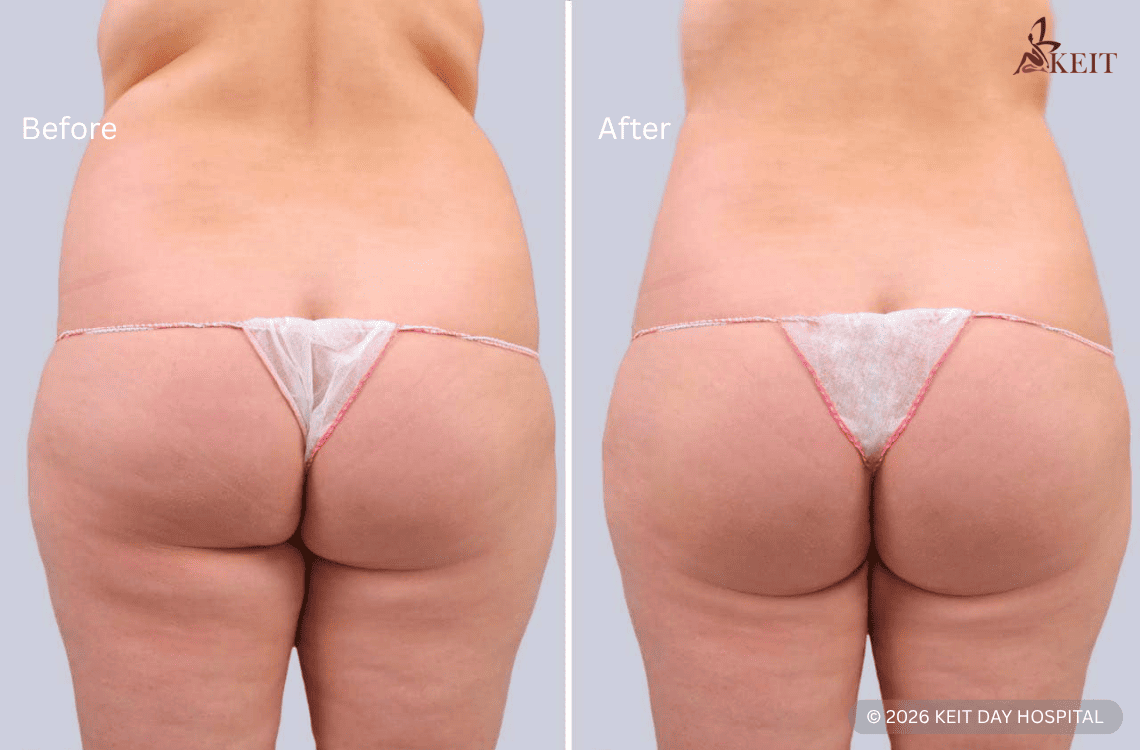
Skinny BBL results are primarily limited by the amount and distribution of available donor fat. In lean patients, the procedure focuses more on body contour refinement than on large volume enhancement.
- Limited volume increase: smaller fat reserves mean a more modest change in buttock size compared to patients with higher body fat.
- Emphasis on shape: the main improvement is contour, projection, and waist-to-hip balance rather than overall enlargement.
- Donor area limitations: fat is typically harvested from multiple areas (abdomen, flanks, thighs) to achieve sufficient graft volume.
- Subtle to moderate outcome: results are generally natural-looking rather than dramatically augmented.

Liquid BBL before and after: how results differ from surgical BBL
Liquid BBL before and after results differ from surgical Brazilian Butt Lift in both the method of enhancement and the longevity of results. The key differences include:
- Immediate volumisation: results are visible straight after treatment due to filler placement in targeted areas.
- No body contouring effect: unlike surgical BBL, there is no fat removal from donor areas, so waist and hip reshaping is not achieved.
- Limited structural change: improvements are mainly in surface volume and roundness rather than full body proportion changes.
- Temporary outcome: results gradually reduce over time as the filler is naturally absorbed by the body, requiring repeat treatments to maintain effect.
BBL before and after over time: how results change long-term
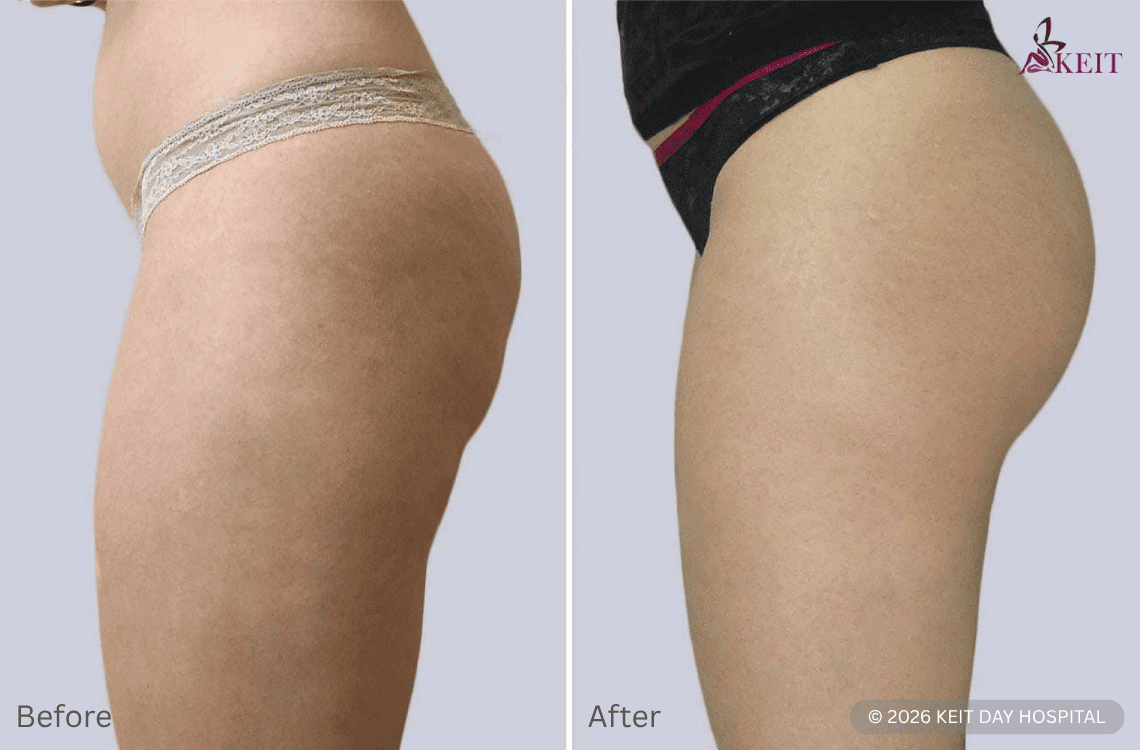
BBL results change over time mainly through gradual fat absorption and natural body adaptation. In the first months, part of the transferred fat is naturally reabsorbed, which slightly reduces initial volume. The remaining fat stabilises and behaves like normal body fat, meaning it can increase or decrease with weight changes. Over the long term, ageing and skin elasticity also influence how firm or lifted the buttock area appears, leading to subtle changes in shape and projection.
What affects BBL results?
BBL results are influenced by several anatomical, technical, and lifestyle factors that determine final shape and fat retention.
- Fat availability: limits the amount of fat that can be harvested and transferred, directly affecting achievable volume.
- Fat transfer technique: influences fat survival, symmetry, and overall contour quality.
- Post-operative care: avoiding pressure on the buttocks supports higher fat retention during the early healing phase.
- Body composition: determines baseline proportions and how balanced the final result appears.
- Skin elasticity: influences how well the soft tissues accommodate increased volume and maintain contour definition.
- Weight stability: maintaining a stable weight is essential for preserving long-term results.
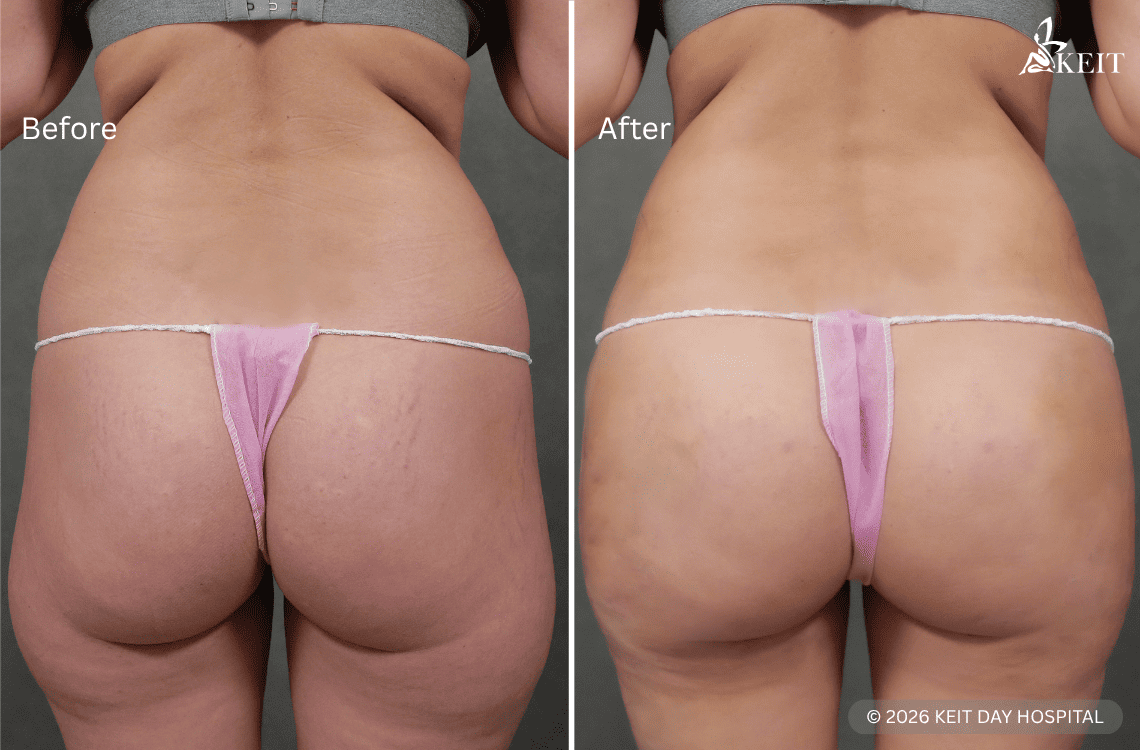
How to evaluate BBL before and after photos correctly
BBL before and after photos should be assessed using proportion, consistency, and clinical accuracy rather than perceived size alone.
- Compare images taken at the same angles, lighting, and posture.
- Focus on overall body proportion, especially waist-to-hip ratio.
- Differentiate early post-operative swelling from healed results.
- Consider the effect of posing, garments, and compression wear.
- Review results across multiple time points, not a single image set.