Published on:
 Modified on:

 Reading Time: 5 min
 Hair transplant
Alopecia areata is a form of autoimmune hair loss in which the immune system mistakenly attacks the hair follicles, causing well-defined areas of hair shedding, usually on the scalp. It can present in several forms, ranging from small patchy areas to more extensive hair loss. Regrowth is possible in many cases, although the course of the condition can be unpredictable.
 Table of Contents:
-
1
 What is alopecia areata?
-
2
Types of alopecia areata
-
3
Alopecia areata symptoms: How to recognize the condition
-
4
What causes alopecia areata?
-
5
Alopecia areata: How is it diagnosed
-
6
Alopecia areata treatment: What are the available options
-
7
Alopecia areata regrowth signs: How long does regrowth take
-
8
Alopecia areata in women, beard and nails: Special patterns to recognize
-
9
Alopecia areata: When should you contact a specialist immediately
In this article, we cover what alopecia areata is, its types, symptoms, causes, diagnosis, treatment options, and regrowth signs. We also look at its presentation in women, the beard, and the nails, as well as when contacting a specialist is essential.
What is alopecia areata?
Alopecia areata is an autoimmune condition that causes sudden, non-scarring hair loss, most often in round or oval patches on the scalp. It develops when the immune system mistakenly targets the hair follicles, interrupting the normal hair growth cycle and leading to localized hair shedding. Because the hair follicles are not permanently destroyed, regrowth remains possible in many cases.
Types of alopecia areata
Alopecia areata can present in several clinical forms, depending on the extent and pattern of hair loss. The main types include:
- Patchy alopecia areata: The most common type, characterized by one or more round bald patches on the scalp or other areas.
- Alopecia totalis: A more advanced form involving complete loss of hair on the scalp.
- Alopecia universalis: The most extensive type, with total loss of hair on the scalp, face, and entire body.
- Ophiasis alopecia areata: Hair loss occurs in a band-like pattern along the sides and back of the scalp.
- Sisaipho alopecia areata: The reverse pattern of ophiasis, where hair loss affects the central scalp while the edges remain intact.
- Diffuse alopecia areata: Characterized by widespread thinning of hair rather than clearly defined bald patches, often resembling other forms of hair loss.
- Alopecia areata incognita: A less visible form with sudden diffuse hair shedding without obvious patches, making diagnosis more challenging.
Alopecia areata symptoms: How to recognize the condition
Alopecia symptoms often appear suddenly and may vary from one person to another. The most common signs include:
- Round or oval bald patches: Small, smooth areas of hair loss that often appear on the scalp.
- Sudden patchy hair loss: Hair may fall out over a short period, leading to visible patches.
- Hair falling out in small clumps: Some people notice increased shedding before a bald patch becomes clearly visible.
- Exclamation mark hairs: Short, broken hairs that are narrower at the base and may be seen around the edges of the patches.
- Itching or tingling of the scalp: Some patients notice mild discomfort, sensitivity, or tingling before hair loss begins.

What causes alopecia areata?
Alopecia areata causes are mainly linked to immune-mediated mechanisms, with genetic and other contributing factors also involved. The main contributing factors include:
- Autoimmune activity: The immune system targets healthy hair follicles, which disrupts normal hair growth and leads to hair loss.
- Genetic predisposition: Some people are more likely to develop alopecia areata because of an inherited tendency.
- Associated autoimmune conditions: Alopecia areata can occur more often in people with other autoimmune disorders, such as thyroid disease or vitiligo.
Triggering factors: In some cases, emotional stress or physical strain may contribute to the onset or worsening of the condition, although they are not considered the primary cause.
Alopecia areata: How is it diagnosed
Alopecia areata is diagnosed through clinical evaluation, supported by specific findings on examination and, in selected cases, additional tests. Diagnosis typically includes:
- Clinical examination: The scalp, hair-bearing areas, and pattern of hair loss are assessed for features suggestive of alopecia areata.
- Medical history: The specialist reviews when the hair loss started, how it has progressed, and whether there is a personal or family history of autoimmune disease.
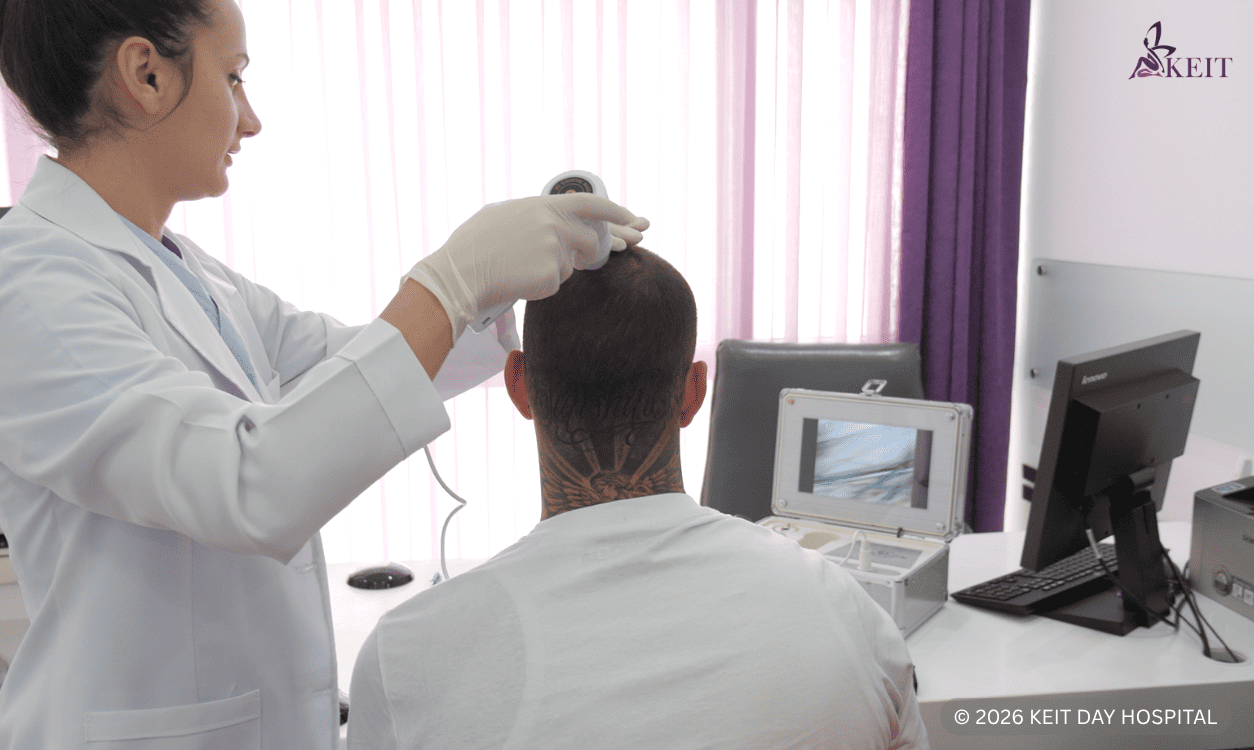
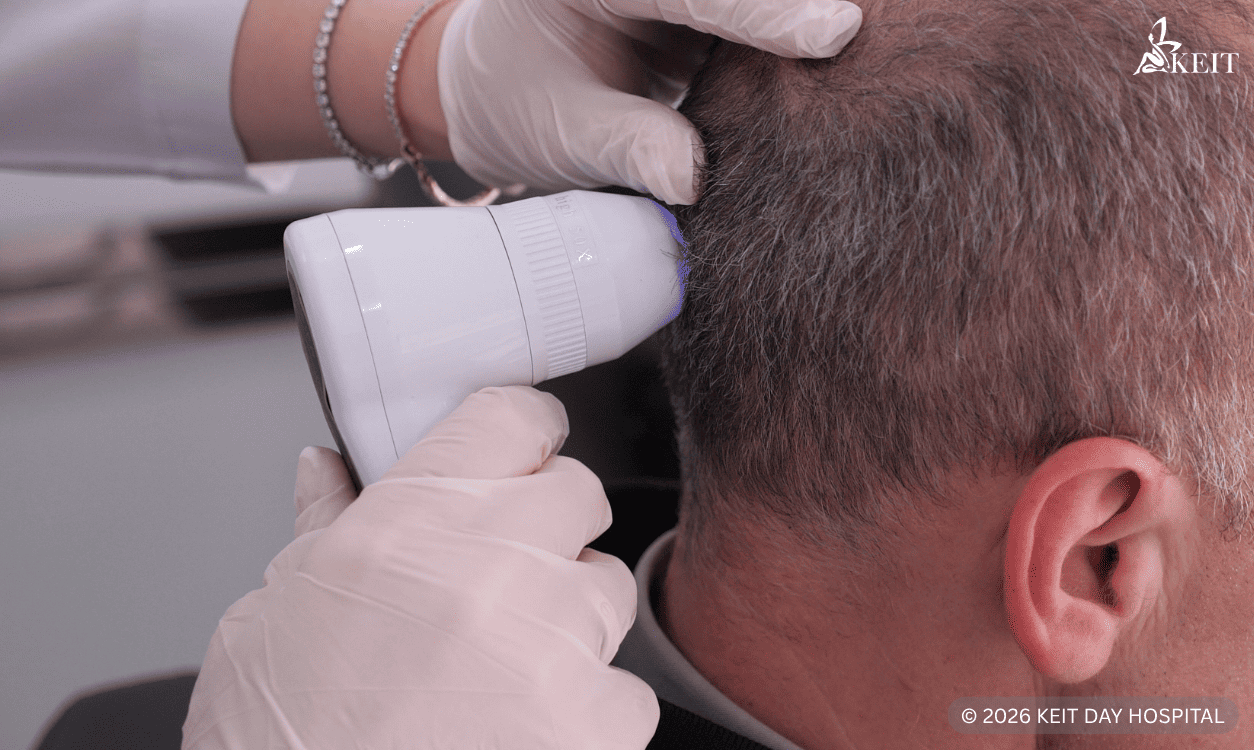
- Trichoscopy (Dermoscopy): A closer examination of the scalp and hair helps identify characteristic signs that support the diagnosis.
- Additional tests: In some cases, blood tests or other investigations may be requested to exclude other causes of hair loss.
Alopecia areata treatment: What are the available options
Treatment for alopecia areata depends mainly on the extent and severity of hair loss. In general, the available options can be grouped as follows:
- Mild: In limited forms, such as one or a few small patches, treatment usually includes topical corticosteroids or intralesional corticosteroid injections to help stimulate regrowth.
- Moderate: When hair loss is more extensive or affects multiple areas, treatment may include topical immunotherapy or other specialist-directed therapies, sometimes in combination with supportive treatments.
- Severe: In extensive cases, such as alopecia totalis or alopecia universalis, systemic treatment may be considered, including oral therapies or newer targeted treatments such as JAK inhibitors, under specialist supervision.
Alopecia areata regrowth signs: How long does regrowth take
Alopecia areata regrowth signs include the appearance of fine hairs, lighter or white regrowing hair, and gradual filling of the bald patches as hair density improves over time.
In most cases, hair regrowth follows this timeline:
- 4–8 weeks: Early regrowth may begin, often with fine, soft hairs appearing in the patches.
- 3–6 months: Visible hair growth increases, and patches start to fill in.
- 6–12 months: Hair becomes thicker and may regain its normal color and texture.
- Beyond 12 months: In some cases, regrowth is complete, while in others hair loss may persist or recur.
Alopecia areata in women, beard and nails: Special patterns to recognize
Alopecia areata may affect different areas in different ways, and some patterns are especially important to recognize in women, the beard area, and the nails.
- Alopecia areata in women: Hair loss may appear as one or more bald patches or, in some cases, as more diffuse thinning, which can make the condition less easy to recognize at an early stage.
- Alopecia areata of the beard: Hair loss affects the beard area and appears as patchy bald spots, most often on the cheeks, jawline, or chin.
- Alopecia areata of the nails: Nail involvement may occur alongside hair loss and usually appears as pitting, ridging, roughness, or increased nail fragility.
Alopecia areata: When should you contact a specialist immediately
You should seek prompt medical advice if you notice any of the following:
- Progressive hair loss: Enlargement of existing patches or the appearance of new ones may suggest ongoing disease activity.
- Hair loss in the beard, eyebrows, or eyelashes: Involvement of these areas may indicate a broader pattern of alopecia areata.
- More extensive forms of alopecia areata: Hair loss affecting the whole scalp or the body may point to a more severe presentation of the condition.
- Recurrent episodes: Hair loss that returns after regrowth can be a sign of ongoing disease activity.