Published on:
 Modified on:

 Reading Time: 5 min
 Hair transplant
Female pattern baldness, also called female pattern hair loss (FPHL) or female androgenetic alopecia, is the most common cause of progressive hair thinning in women. It is a chronic, genetically influenced condition where scalp follicles gradually miniaturize, producing finer, shorter hairs and reduced density over time. Early recognition, accurate diagnosis and evidence-based treatment are key to slowing progression and preserving hair.
 Table of Contents:
-
1
 What is female pattern baldness?
-
2
What causes female pattern baldness?
-
3
Early signs of female pattern hair loss to recognize
-
4
Female pattern baldness stages and severity: Clinical classification
-
5
Female pattern baldness vs telogen effluvium: Key differences explained
-
6
How is female pattern baldness diagnosed?
-
7
Female pattern hair loss treatment: What actually works
-
8
Hair loss female pattern baldness: When to see a specialist
-
9
Hair transplant for female androgenetic alopecia: When is it indicated?
In this guide, we cover what female pattern baldness is and what causes it, the early signs that often appear first and how severity is classified over time. We also explain the key differences from telogen effluvium, what the diagnostic process typically includes, which treatments are evidence-based and realistic, when specialist assessment is recommended and when a hair transplant may be considered as part of a long-term plan.
What is female pattern baldness?
Female pattern baldness is a non-scarring form of hair loss caused by an inherited sensitivity of scalp hair follicles to androgens, particularly dihydrotestosterone (DHT). The scalp skin remains healthy, but affected follicles gradually shrink, producing progressively finer and less pigmented hairs with each growth cycle.
Complete baldness is rare, but loss of volume and coverage can be cosmetically and emotionally distressing. Since shedding is often mild, many women do not recognize the condition until thinning becomes clearly visible.
What causes female pattern baldness?
Female pattern baldness develops from the interaction between genetic predisposition and increased follicle sensitivity to androgens, rather than from high testosterone levels.
- Genetics: FPHL is often inherited (from either parent), making certain scalp follicles more prone to thinning over time.
- Androgen sensitivity (DHT): It’s not “too much testosterone”, but susceptible follicles react strongly to normal DHT signaling, pushing the cycle toward thinning.
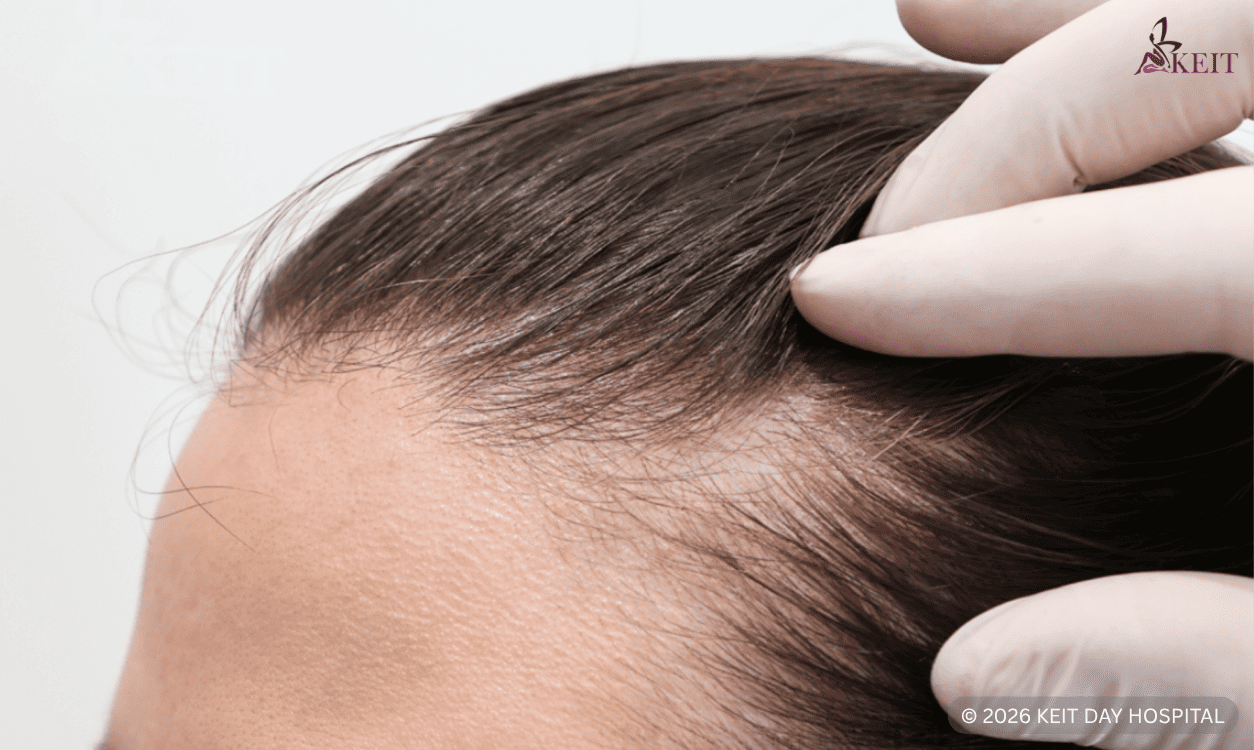
- Miniaturization: Over time, the growth phase shortens, hairs become finer/shorter and density drops, usually at the central scalp with a widening part or crown thinning.
- Age and menopause: Thinning often becomes more noticeable with age and may speed up around perimenopause/menopause as estrogen declines and androgen influence becomes relatively stronger.
Factors that can make thinning more noticeable
Especially in women who already have or are predisposed to female pattern hair loss (FPHL), the following factors can increase shedding or make thinning look worse:
- Hormonal conditions (PCOS): Higher androgen activity can intensify follicle sensitivity and speed up pattern thinning.
- Stress and major physical events: Illness, surgery or childbirth can trigger telogen effluvium, temporarily increasing shedding and revealing underlying FPHL.
- Nutritional deficiencies: Low iron stores (low ferritin) can worsen shedding, reduce hair quality and limit response to treatment.
- Thyroid disorders, medical conditions or medications: These can disrupt the hair cycle, prolong shedding phases and compound overall density loss.

Early signs of female pattern hair loss to recognize
Early detection plays a key role in treatment success. Common early signs include:
- Gradual widening of the central part.
- Reduced ponytail thickness.
- Increased scalp visibility under bright lighting.
- Hair becomes finer or weaker over time.
- Progressive thinning without obvious excessive shedding.
Female pattern baldness stages and severity: Clinical classification
Female pattern baldness progresses at different speeds. Severity is commonly described using clinical grading systems such as the Ludwig or Sinclair scales, which help guide treatment planning and prognosis.
- Mild stages: Minimal widening of the part line, subtle crown thinning.
- Moderate stages: Noticeable diffuse thinning across the central scalp.
- Advanced stages: Significant density loss with clear scalp visibility.
Understanding the stage helps set realistic expectations and determine the most appropriate treatment approach.
Female pattern baldness vs telogen effluvium: Key differences explained
Female pattern baldness is frequently confused with telogen effluvium (TE), but these conditions differ in cause and behavior.
- Telogen effluvium causes sudden, diffuse shedding across the entire scalp, often following stress, illness, surgery, childbirth or medication changes. Hair density and pattern are usually preserved.
- Female pattern baldness develops gradually, follows a recognizable pattern (central scalp and crown) and involves follicular miniaturization rather than acute shedding.
Can both occur together?
Yes. Telogen effluvium can overlap with female pattern baldness, making thinning appear sudden. Once shedding resolves, the underlying pattern thinning remains and requires long-term management.
How is female pattern baldness diagnosed?
Diagnosis of female pattern baldness (FPHL) is mainly clinical, based on the pattern of thinning and signs of follicle miniaturization.
- History: Onset (gradual vs sudden), recent triggers (illness, surgery, childbirth, weight loss, medication changes), family history and hormonal clues (irregular cycles, acne, excess facial/body hair suggestive of PCOS).
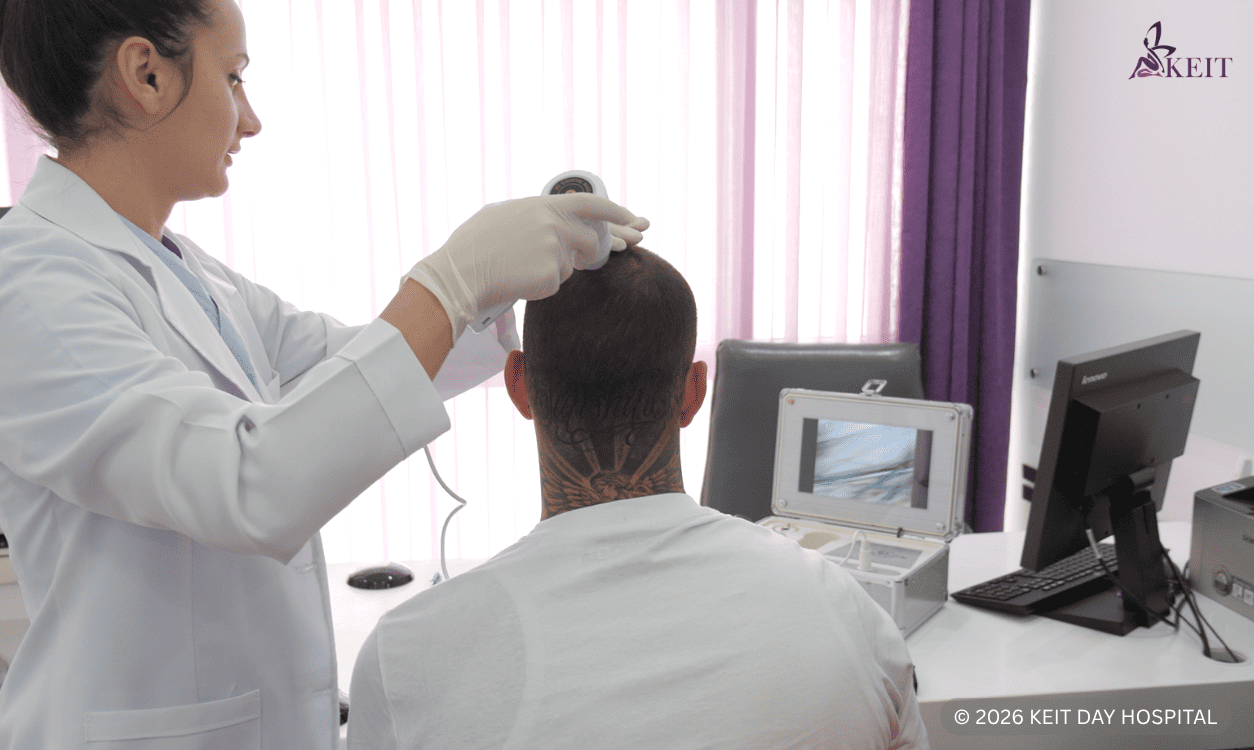
- Scalp exam + trichoscopy: Checks for central scalp/crown thinning with a widening part and miniaturization (mixed thick + thin hairs, reduced density).
- Blood tests (when indicated): Especially if shedding is diffuse/rapid or symptoms exist. Common checks include ferritin/iron status and thyroid function, plus hormonal testing when clinically relevant.
Female pattern hair loss treatment: What actually works
Female pattern baldness requires long-term management, not short-term fixes. Treatment success depends on early intervention, consistency and evidence-based approaches.
Medical treatments
- Minoxidil (topical or oral in selected cases) prolongs the growth phase and improves hair thickness and density.
- Anti-androgen therapies (such as spironolactone in appropriate patients) may reduce androgen effects at the follicular level.
These treatments do not cure FPHL, but they can significantly slow progression and improve hair quality when used correctly.
PRP and regenerative treatments
Platelet-rich plasma (PRP) may support follicular activity and improve hair caliber, particularly in early to moderate stages. Best results are seen when PRP is combined with medical therapy.

Low-level laser light therapy (LLLT)
LLLT devices may modestly improve thickness in some women and are best considered an adjunct rather than a standalone treatment.
Hair loss female pattern baldness: When to see a specialist
Specialist assessment is recommended when:
- Thinning progresses over several months.
- The part or crown becomes visibly wider.
- Hair loss begins at a young age.
- Shedding is persistent or unexplained.
- There is uncertainty between telogen effluvium and pattern hair loss.
Evaluation typically includes a clinical scalp exam, trichoscopy and targeted blood tests when indicated.
Hair transplant for female androgenetic alopecia: When is it indicated?
Hair transplantation can be effective in carefully selected women, but it is not suitable for all cases of female pattern baldness. Best candidates usually have:
- Stable, recognizable thinning patterns.
- A confirmed strong donor area.
- Controlled shedding and stabilized hair loss.
- Realistic expectations within a long-term plan.
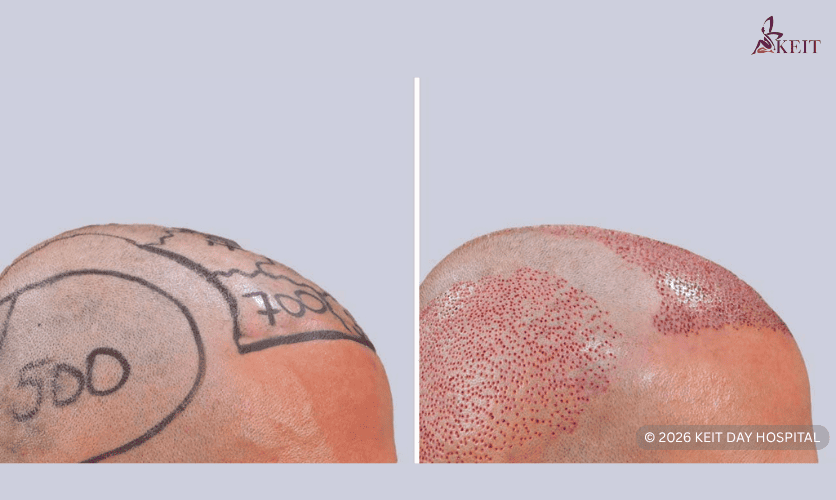
A hair transplant does not stop female pattern baldness. It redistributes resistant follicles to improve density in targeted areas, so ongoing medical or regenerative therapy is often required to protect existing non-transplanted hair.
If you’re at an early stage of research, explore our ultimate guide to understand what a hair transplant is, how follicles are harvested and why donor dominance drives long-term results.